

CS310 Quiz 2 Solution and Discussion
-
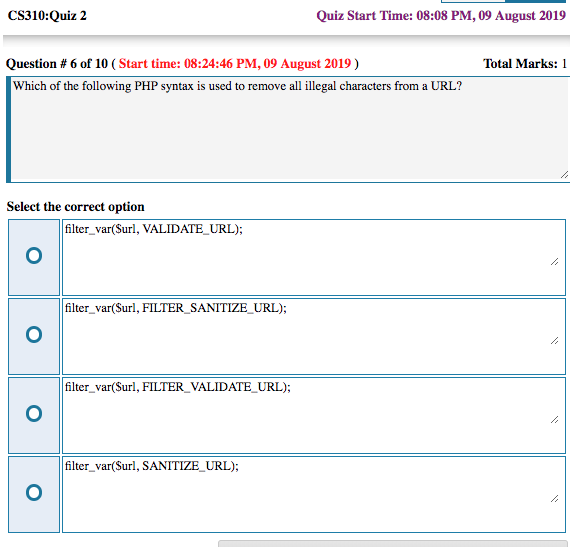
Which of the following PHP syntax is used to remove all illegal characters from a URL?
Discussion is right way to get Solution of the every assignment, Quiz and GDB.
We are always here to discuss and Guideline, Please Don't visit Community only for Solution.
Community Team always happy to facilitate to provide the idea solution. Please don't hesitate to contact us!
[NOTE: Don't copy or replicating idea solutions.]
VU Handouts
Quiz Copy Solution
Mid and Final Past Papers
Live Chat -
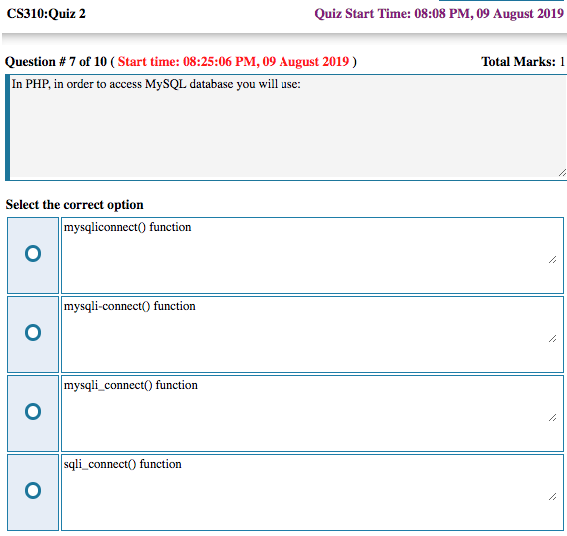
In PHP, in order to access MySQL database you will use:
Discussion is right way to get Solution of the every assignment, Quiz and GDB.
We are always here to discuss and Guideline, Please Don't visit Community only for Solution.
Community Team always happy to facilitate to provide the idea solution. Please don't hesitate to contact us!
[NOTE: Don't copy or replicating idea solutions.]
VU Handouts
Quiz Copy Solution
Mid and Final Past Papers
Live Chat -
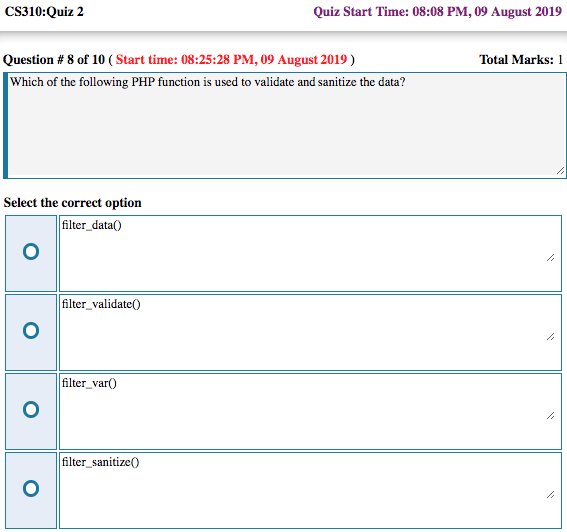
Which of the following PHP function is used to validate and sanitize the data?
Discussion is right way to get Solution of the every assignment, Quiz and GDB.
We are always here to discuss and Guideline, Please Don't visit Community only for Solution.
Community Team always happy to facilitate to provide the idea solution. Please don't hesitate to contact us!
[NOTE: Don't copy or replicating idea solutions.]
VU Handouts
Quiz Copy Solution
Mid and Final Past Papers
Live Chat -
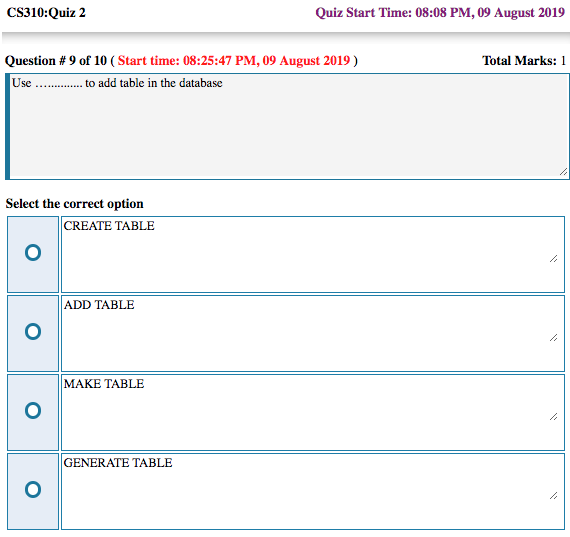
Use …… to add table in the database
Discussion is right way to get Solution of the every assignment, Quiz and GDB.
We are always here to discuss and Guideline, Please Don't visit Community only for Solution.
Community Team always happy to facilitate to provide the idea solution. Please don't hesitate to contact us!
[NOTE: Don't copy or replicating idea solutions.]
VU Handouts
Quiz Copy Solution
Mid and Final Past Papers
Live Chat -
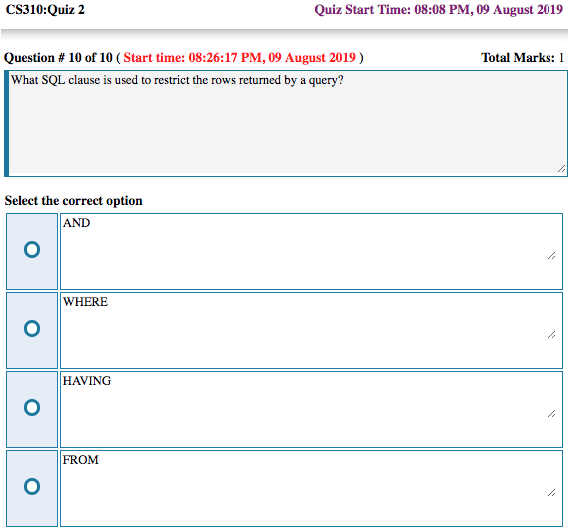
What SQL clause is used to restrict the rows returned by a query?
Discussion is right way to get Solution of the every assignment, Quiz and GDB.
We are always here to discuss and Guideline, Please Don't visit Community only for Solution.
Community Team always happy to facilitate to provide the idea solution. Please don't hesitate to contact us!
[NOTE: Don't copy or replicating idea solutions.]
VU Handouts
Quiz Copy Solution
Mid and Final Past Papers
Live Chat -
said in CS310 Quiz 2 Solution and Discussion:
What SQL clause is used to restrict the rows returned by a query?
The SQL clause used to restrict or filter rows based on a specific condition is the WHERE clause.
It is placed after the
FROMclause and before any grouping or sorting clauses. Only the rows that meet the specified criteria (where the condition evaluates to TRUE) will be included in the result set.Basic Syntax
SELECT column1, column2
FROM table_name
WHERE condition;
Examples of Usage
Requirement SQL Example Exact Match WHERE city = 'London'Numeric Range WHERE age > 18Pattern Matching WHERE name LIKE 'A%'Multiple Conditions WHERE price < 100 AND stock > 0A Quick Distinction: WHERE vs. HAVING
- WHERE: Filters individual rows before any grouping occurs.
- HAVING: Filters groups after the
GROUP BYclause has been applied.
-
 Z zaasmi has marked this topic as solved on
-
said in CS310 Quiz 2 Solution and Discussion:
Use …… to add table in the database
To add a new table to a database, you use the
CREATE TABLEstatement.This command defines the table name and specifies the columns, including their data types (e.g.,
INT,VARCHAR,DATE) and any constraints (e.g.,PRIMARY KEY,NOT NULL).Basic Syntax
CREATE TABLE table_name (
    column1 datatype constraint,
    column2 datatype constraint,
    column3 datatype constraint
);
Practical Example
If you wanted to create a table to store student information, the query would look like this:
CREATE TABLE Students (
    StudentID int PRIMARY KEY,
    FirstName varchar(50),
    LastName varchar(50),
    EnrollmentDate date
);
Key Points to Remember
- Unique Name: The table name must be unique within the database.
- Data Types: You must define what kind of data each column will hold.
- Primary Key: It is best practice to include a Primary Key to uniquely identify each row in your table.
-
said in CS310 Quiz 2 Solution and Discussion:
Which of the following PHP function is used to validate and sanitize the data?
The PHP function used for both validating and sanitizing data is
filter_var().This function is highly versatile because it allows you to check if data is in the correct format (Validation) or remove illegal characters from data (Sanitization) simply by changing the “filter” flag you pass to it.
1. Validation
Validation checks if the data meets certain criteria. If it doesn’t, the function returns
false.- Example: Checking if an email is valid.
if (filter_var("test@example.com", FILTER_VALIDATE_EMAIL)) {
    echo "Valid email address.";
}
2. Sanitization
Sanitization cleans the data by removing or encoding characters that could be harmful or unwanted.
- Example: Removing HTML tags from a string.
$clean_string = filter_var("<h1>Hello!</h1>", FILTER_SANITIZE_STRING);
// Result: "Hello!"
Common Filter Constants
Filter Constant Purpose FILTER_VALIDATE_EMAILValidates an email address. FILTER_VALIDATE_INTValidates an integer. FILTER_VALIDATE_URLValidates a URL. FILTER_SANITIZE_EMAILRemoves all characters except letters, digits and !#$%&'*±/=?^_`{|}~@.[]. | Why use
filter_var()?It is much safer and more reliable than using custom Regular Expressions (Regex). Using these built-in filters helps protect your application against common security vulnerabilities like Cross-Site Scripting (XSS) and SQL Injection.
-
said in CS310 Quiz 2 Solution and Discussion:
In PHP, in order to access MySQL database you will use:
Answer: mysqli_connect() function
In modern PHP, you have two primary, recommended ways to access a MySQL database. While older versions used the
mysql_extension, that has been deprecated and removed for security reasons.Today, you should use one of the following:
1. MySQLi (MySQL Improved)
This is a driver specifically designed for MySQL databases. It supports both procedural (using functions) and object-oriented (using classes) programming styles.
- Best for: Projects that only use MySQL and want to take advantage of MySQL-specific features like stored procedures.
// Object-oriented example
$conn = new mysqli("localhost", "username", "password", "database");
2. PDO (PHP Data Objects)
PDO is a database abstraction layer. It provides a consistent way to interact with many different types of databases (MySQL, PostgreSQL, SQLite, etc.).
- Best for: Flexibility. If you ever decide to switch your database from MySQL to another system, you won’t have to rewrite your entire data access code.
// PDO example
$dsn = "mysql:host=localhost;dbname=testdb";
$conn = new PDO($dsn, "username", "password");
Comparison at a Glance
Feature MySQLi PDO Database Support MySQL only 12 different drivers Programming Style Procedural & OO Object-Oriented only Prepared Statements Supported (Secure) Supported (Secure) Named Parameters Not supported Supported Security Note: Regardless of which you choose, always use Prepared Statements to protect your database from SQL Injection attacks.
-
said in CS310 Quiz 2 Solution and Discussion:
Which of the following PHP syntax is used to remove all illegal characters from a URL?
To remove all illegal characters from a URL in PHP, you use the
filter_var()function combined with theFILTER_SANITIZE_URLconstant.The Syntax
$url = "https://example.com/search?q=hello world!";
$clean_url = filter_var($url, FILTER_SANITIZE_URL);
How it Works
This specific filter is designed to clean a string by removing characters that are not permitted in a URL. It allows all letters, digits, and the following special characters:
$-_.+!*'(),{}|\\^~[]<>#%";/?:@&=`Key Differences in URL Handling
It is important to distinguish between sanitizing (cleaning) and validating (checking):
Function Goal Filter Constant Result Sanitize FILTER_SANITIZE_URLReturns a “clean” string with illegal characters removed. Validate FILTER_VALIDATE_URLReturns the URL if it’s in a valid format, or falseif it isn’t.
Would you like me to show you how to combine both to first clean a URL and then check if the result is actually valid?
-
said in CS310 Quiz 2 Solution and Discussion:
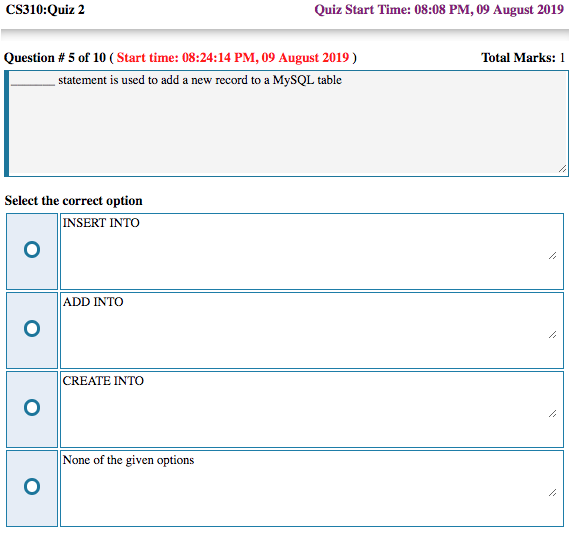
_______ statement is used to add a new record to a MySQL table
The
INSERT INTOstatement is used to add a new record (row) to a MySQL table.Basic Syntax
There are two primary ways to write this statement:
1. Specifying both column names and values:
This is the safest method as it ensures data goes into the correct fields.INSERT INTO table_name (column1, column2, column3) VALUES (value1, value2, value3);2. Specifying values only:
You can omit column names if you are providing values for every column in the exact order they appear in the table.INSERT INTO table_name VALUES (value1, value2, value3);
Practical Example
If you have a table named
Users, you would add a new person like this:INSERT INTO Users (username, email, age) VALUES ('jdoe', 'john@example.com', 25);Key Tips
- Strings: Always wrap text/string values in single quotes (e.g.,
'Hello'). - Numbers: Numeric values do not require quotes.
- Auto-Increment: If your table has an
idcolumn set toAUTO_INCREMENT, you don’t need to include it in yourINSERTstatement; MySQL will generate the number for you automatically.
- Strings: Always wrap text/string values in single quotes (e.g.,
-
How will we retrieve the value of session variable set in the following PHP code?
$_SESSION[“color”] = “green”;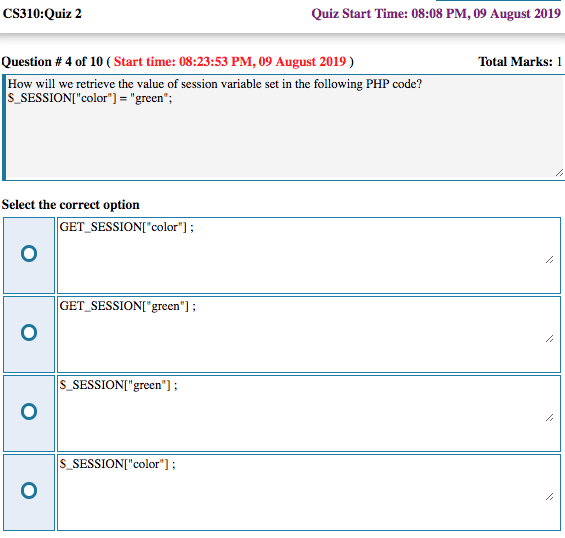
said in CS310 Quiz 2 Solution and Discussion:
How will we retrieve the value of session variable set in the following PHP code?
Retrieve session variable
Answer: (d) $_SESSION[“color”];$
The session variable is stored in the superglobal array $_SESSION with the key “color”. To retrieve its value, you must access this specific array using the same key. The other options use incorrect array names or incorrect keys.To retrieve a session variable in PHP, you access the
$_SESSIONsuperglobal array using the specific key (name) that was used to set it.The Syntax
If your session variable was set like this:
$_SESSION['username'] = "Alex";You retrieve it like this:
echo $_SESSION['username'];
Important Steps for Retrieval
For the value to be accessible, you must follow these two rules:
- Start the Session: You must call
session_start();at the very top of your PHP file before trying to access the$_SESSIONarray. - Check if it Exists: It is best practice to use
isset()to avoid an “Undefined index” error in case the session has expired or wasn’t set.
Example Code:
<?php
session_start(); // Mandatory to access session data

if(isset($_SESSION['username'])) {
    echo "Welcome back, " . $_SESSION['username'];
} else {
    echo "User is not logged in.";
}
?>
Summary of Session Functions
Action PHP Command Start/Resume session_start();Set/Retrieve $_SESSION['key']Remove one variable unset($_SESSION['key']);Destroy all data session_destroy();Would you like me to show you the specific code to set a session variable first, or perhaps how to destroy a session when a user logs out?
- Start the Session: You must call
-
said in CS310 Quiz 2 Solution and Discussion:
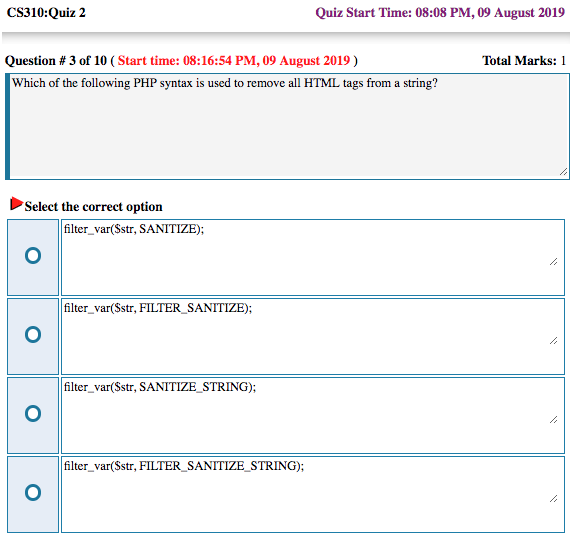
Which of the following PHP syntax is used to remove all HTML tags from a string? CS310
To remove all HTML tags from a string in PHP, you use the
filter_var()function with theFILTER_SANITIZE_STRINGconstant or thestrip_tags()function.1. Using
filter_var()(Standard for sanitization)This is the modern approach for cleaning input data.
$input = "<h1>Hello</h1> <p>World!</p>";
$clean = filter_var($input, FILTER_SANITIZE_STRING);
// Result: "Hello World!"
Note: As of PHP 8.1.0,
FILTER_SANITIZE_STRINGis deprecated. While still common in exam questions (like CS310), the modern replacement ishtmlspecialchars()orstrip_tags().2. Using
strip_tags()(Dedicated function)This is a very common and straightforward function specifically designed to strip HTML and PHP tags from a string.
$input = "<b>Bold Text</b>";
echo strip_tags($input);
// Result: "Bold Text"
Comparison of Methods
Method Best Use Case Key Feature strip_tags()General purpose stripping Allows you to specify “allowable tags” that should NOT be removed. filter_var()Data sanitization pipelines Part of a unified filtering system for emails, URLs, and integers. htmlspecialchars()Security (XSS prevention) Doesn’t remove tags, but converts them to plain text so the browser won’t execute them. Would you like me to show you how to use
strip_tags()while keeping certain tags (like<b>or<i>) intact? -
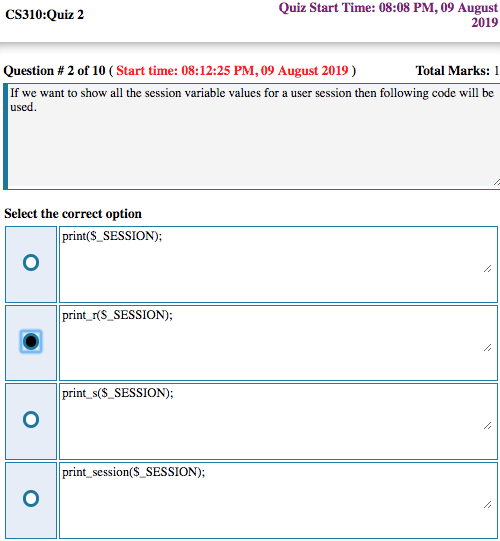
If we want to show all the session variable values for a user session then following code will be used.
print_r($_SESSION);
said in CS310 Quiz 2 Solution and Discussion:
If we want to show all the session variable values for a user session then following code will be used.
To see every variable currently stored in a user’s session, you use the
print_r()orvar_dump()function on the$_SESSIONsuperglobal.These functions allow you to output the entire contents of the associative array in a readable format, which is extremely helpful for debugging.
The Code
<?php
session_start(); // You must always start the session first

// Option 1: Using print_r (Cleanest for reading)
echo "<pre>";
print_r($_SESSION);
echo "</pre>";

// Option 2: Using var_dump (Provides more detail like data types)
var_dump($_SESSION);
?>
Why use
<pre>?When using
print_r()orvar_dump(), wrapping the code in HTML<pre>(preformatted text) tags is a “pro-tip.” It forces the browser to display the array with proper indentation and line breaks, making it much easier for you to read than a single long line of text.Common Session Commands Summary
Purpose Command Start/Resume session_start();Show All Values print_r($_SESSION);Check if a variable exists isset($_SESSION['key']);Clear all values session_unset();Would you like me to show you how to loop through the session variables using a
foreachloop if you want to format the output as a list?

Reputation Earning
 World CUP LIVE Matches

Sponsored
File Sharing