
ENG517 Quiz No. III Solution and Discussion
-
An important activity in the classroom which encourages both social and thinking skills and mirrors the way in which learners often need to work in an academic setting is known as __________.

Discussion is right way to get Solution of the every assignment, Quiz and GDB.
We are always here to discuss and Guideline, Please Don't visit Community only for Solution.
Community Team always happy to facilitate to provide the idea solution. Please don't hesitate to contact us!
[NOTE: Don't copy or replicating idea solutions.]
VU Handouts
Quiz Copy Solution
Mid and Final Past Papers
Live Chat -
The _________ works as a central process in cooperative learning and confirms its social and democratic nature.

Discussion is right way to get Solution of the every assignment, Quiz and GDB.
We are always here to discuss and Guideline, Please Don't visit Community only for Solution.
Community Team always happy to facilitate to provide the idea solution. Please don't hesitate to contact us!
[NOTE: Don't copy or replicating idea solutions.]
VU Handouts
Quiz Copy Solution
Mid and Final Past Papers
Live Chat -
The learner’s behaviour of __________ is considered as non-verbal behaviour involved in non-verbal discourse strategies.

Discussion is right way to get Solution of the every assignment, Quiz and GDB.
We are always here to discuss and Guideline, Please Don't visit Community only for Solution.
Community Team always happy to facilitate to provide the idea solution. Please don't hesitate to contact us!
[NOTE: Don't copy or replicating idea solutions.]
VU Handouts
Quiz Copy Solution
Mid and Final Past Papers
Live Chat -
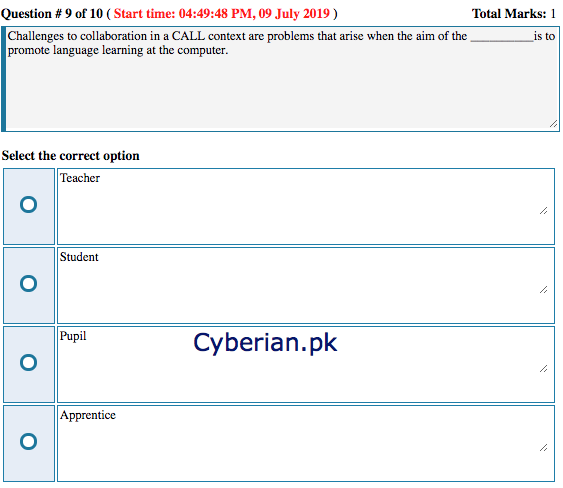
Challenges to collaboration in a CALL context are problems that arise when the aim of the __________is to promote language learning at the computer.
Discussion is right way to get Solution of the every assignment, Quiz and GDB.
We are always here to discuss and Guideline, Please Don't visit Community only for Solution.
Community Team always happy to facilitate to provide the idea solution. Please don't hesitate to contact us!
[NOTE: Don't copy or replicating idea solutions.]
VU Handouts
Quiz Copy Solution
Mid and Final Past Papers
Live Chat -
In 1988 Sharan and Shachar offered the _____________ strategies used in collaborative learning discussions.

Discussion is right way to get Solution of the every assignment, Quiz and GDB.
We are always here to discuss and Guideline, Please Don't visit Community only for Solution.
Community Team always happy to facilitate to provide the idea solution. Please don't hesitate to contact us!
[NOTE: Don't copy or replicating idea solutions.]
VU Handouts
Quiz Copy Solution
Mid and Final Past Papers
Live Chat -
In the process of ____________ the learner shows willingness to listen to others’ ideas and suggestions, so that they can be discussed and integrated into further actions like decision making.

said in ENG517 Quiz No. III Solution and Discussion:
In the process of ____________ the learner shows willingness to listen to others’ ideas and suggestions, so that they can be discussed and integrated into further actions like decision making.
Based on the description provided, none of the options you listed (Individual work, Singular task, or One man show) are correct. In fact, those three options represent the exact opposite of what is being described.
The process where a learner listens to others, discusses ideas, and integrates them into decision-making is a Collaborative or Participative process.
Why your options don’t fit:
- Individual work / Singular task: These imply working alone without seeking input or suggestions from others.
- One man show: This refers to a situation where one person makes all the decisions and does all the work without any external integration.
The Correct Concept: Collaborative Learning / Participative Decision Making
In MGT301 or educational psychology, this process is usually referred to as Collaborative Learning or Participative Decision Making.
If this is a multiple-choice question from a quiz and you must choose from a specific set of terms, the correct term is likely:
Teamwork or Group Discussion.Key Characteristics of this Process:
- Openness: The learner is not defensive about their own ideas.
- Synergy: The idea that the “whole is greater than the sum of its parts” (1 + 1 = 3).
- Two-way Communication: Information flows back and forth rather than just from the top down.
If you have the full list of options from your quiz, please share them! I can help you identify the specific technical term your textbook is looking for.
-
 Z zaasmi has marked this topic as solved on
-
In 1988 Sharan and Shachar offered the _____________ strategies used in collaborative learning discussions.
said in ENG517 Quiz No. III Solution and Discussion:
In 1988 Sharan and Shachar offered the _____________ strategies used in collaborative learning discussions.
- Sharan and Shachar strategies
Answer: (b) Cognitive
In 1988, Sharan and Shachar offered the cognitive strategies used in collaborative learning discussions. Their work focused on the cognitive processes involved in group interactions and how these strategies facilitate learning.
- Sharan and Shachar strategies
-
Challenges to collaboration in a CALL context are problems that arise when the aim of the __________is to promote language learning at the computer.
said in ENG517 Quiz No. III Solution and Discussion:
Challenges to collaboration in a CALL context are problems that arise when the aim of the __________is to promote language learning at the computer.
- Challenges to collaboration in a CALL context
Answer: (b) Student
The question asks who the aim of promoting language learning at the computer is for in a CALL (Computer-Assisted Language Learning) context. The primary beneficiary and focus of language learning initiatives are the students or learners. Therefore, challenges to collaboration arise when the aim is to promote language learning for the Student at the computer.
- Challenges to collaboration in a CALL context
-
The learner’s behaviour of __________ is considered as non-verbal behaviour involved in non-verbal discourse strategies.
said in ENG517 Quiz No. III Solution and Discussion:
The learner’s behaviour of __________ is considered as non-verbal behaviour involved in non-verbal discourse strategies.
- Non-verbal discourse strategies
Answer: Silent reading
Silent reading involves processing text internally without producing audible sound or physical non-verbal behaviors that are part of discourse strategies like gestures, posture, or facial expressions used during speaking or oral presentations. Therefore, it is considered as non-verbal behavior involved in non-verbal discourse strategies.
- Non-verbal discourse strategies
-
The _________ works as a central process in cooperative learning and confirms its social and democratic nature.
said in ENG517 Quiz No. III Solution and Discussion:
The _________ works as a central process in cooperative learning and confirms its social and democratic nature.
- Cooperative Learning Process
Answer: (a) making public
The process of making public works as a central process in cooperative learning and confirms its social and democratic nature. This is because cooperative learning involves students working together in groups to achieve shared goals, which inherently requires the sharing of ideas, information, and results among group members and often with the wider class or community. This public sharing and discussion fosters social interaction, communication skills, and a democratic environment where all voices can be heard and valued.
- Cooperative Learning Process
-
An important activity in the classroom which encourages both social and thinking skills and mirrors the way in which learners often need to work in an academic setting is known as __________.
said in ENG517 Quiz No. III Solution and Discussion:
An important activity in the classroom which encourages both social and thinking skills and mirrors the way in which learners often need to work in an academic setting is known as __________.
- Classroom activity for social and thinking skills
Answer: © Collaboration
An important activity in the classroom that encourages both social and thinking skills, mirroring the way learners often need to work in an academic setting, is known as collaboration. This approach involves individuals working together to achieve a common goal, fostering communication, problem-solving, and teamwork abilities. The other options (individual work, singular task, one man show) focus on solo efforts, which do not inherently promote social skills in the same way.
- Classroom activity for social and thinking skills
-
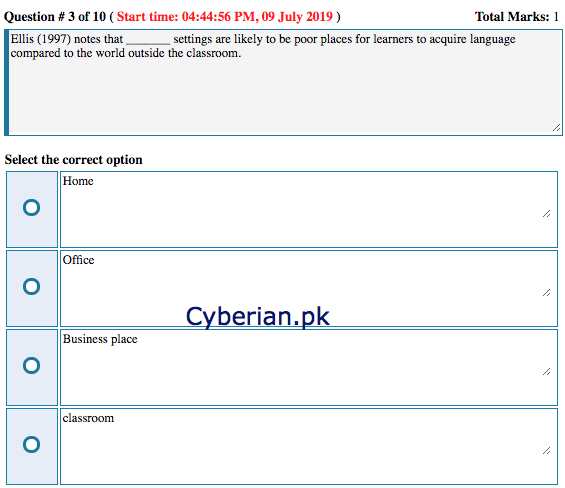
Ellis (1997) notes that _______ settings are likely to be poor places for learners to acquire language compared to the world outside the classroom.
said in ENG517 Quiz No. III Solution and Discussion:
Ellis (1997) notes that _______ settings are likely to be poor places for learners to acquire language compared to the world outside the classroom.
Answer: (d) classroom
Ellis (1997) notes that classroom settings are likely to be poor places for learners to acquire language compared to the world outside the classroom. The image provides this information in the text itself. -
Repeating what was just read or said is counted under the ___________ category of ‘Verbal Discourse Strategies Responses’.

said in ENG517 Quiz No. III Solution and Discussion:
Repeating what was just read or said is counted under the ___________ category of ‘Verbal Discourse Strategies Responses’.
- Repeating what was just read or said
Answer: (b) Copying
Repeating what was just read or said falls under the ‘Copying’ category of ‘Verbal Discourse Strategies Responses’. This term specifically refers to the act of directly reproducing information heard or read, without significant modification or original thought.
- Repeating what was just read or said
-
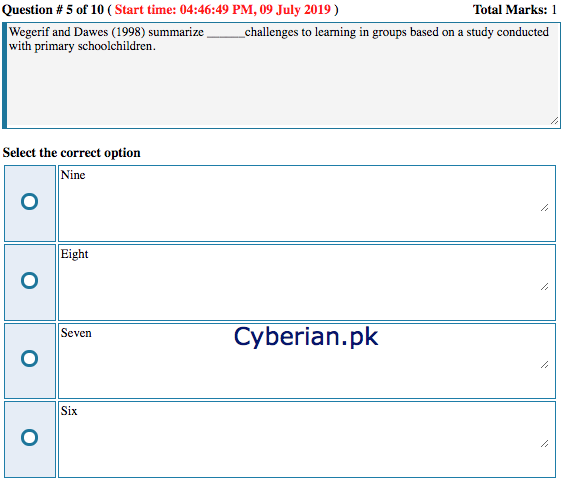
Wegerif and Dawes (1998) summarize ______challenges to learning in groups based on a study conducted with primary schoolchildren.
said in ENG517 Quiz No. III Solution and Discussion:
Wegerif and Dawes (1998) summarize ______challenges to learning in groups based on a study conducted with primary schoolchildren.
- Challenges to learning in groups
Answer: Eight
Wegerif and Dawes (1998) summarized eight main challenges to learning in groups based on their study with primary schoolchildren. These challenges were identified within the context of using computers to support exploratory talk in the classroom and included issues related to managing different types of talk (Disputational, Cumulative, and Exploratory) and ensuring productive collaboration among students.
- Challenges to learning in groups
Reputation Earning
 World CUP LIVE Matches

Ads
File Sharing